Step Inside the World of Dior – From Post-War Elegance to Digital Innovation
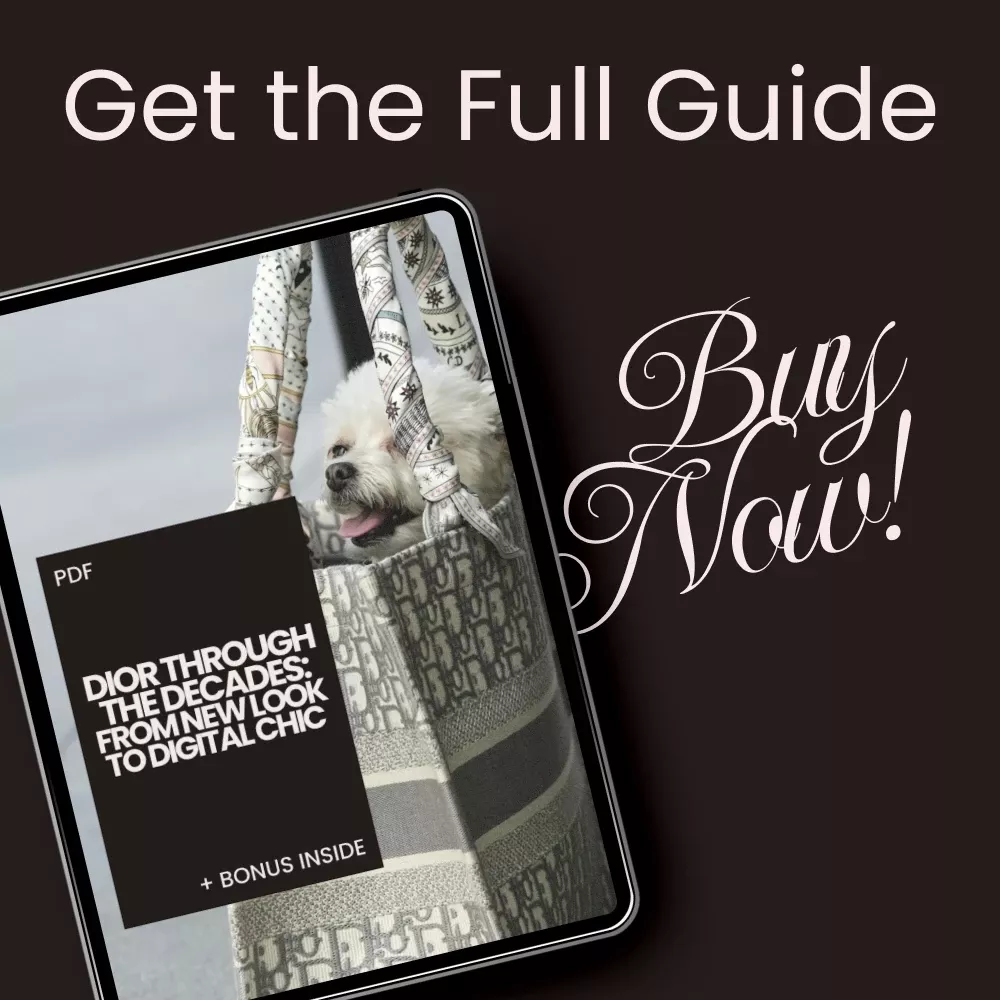
Discover the artistry, ambition, and reinvention behind one of fashion’s most iconic houses. Dior Through the Decades: From New Look to Digital Chic is a beautifully structured digital eBook that explores how dior style has evolved from Christian Dior’s revolutionary 1947 silhouette to today’s tech-driven couture and virtual runway experiences. Whether you are a fashion student, stylist, vintage lover, or creative entrepreneur, this guide gives you both historical depth and modern insight in one compelling read.
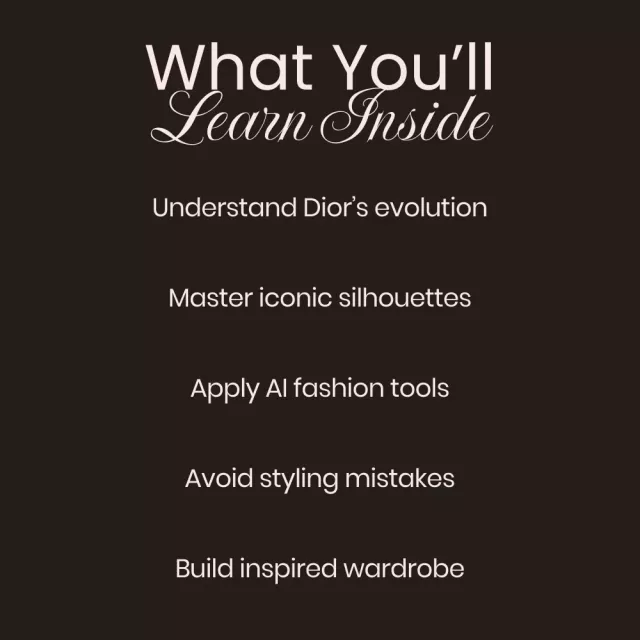
What’s Inside This eBook
- Chapter 1: The birth of Dior and the groundbreaking 1947 “New Look” revolution, plus a case study on its post-war cultural impact and AI insights on digitizing Dior archives.
- Chapter 2: The elegance of the 50s and 60s, expansion into accessories and fragrances, common silhouette mistakes in vintage fashion, and AI tools predicting revival trends.
- Chapter 3: The bold experimentation of the 70s and 80s, Dior in pop culture, and AI prompts to generate 80s-inspired looks.
- Chapter 4: The dramatic Galliano era, runway spectacle, and virtual runway simulations powered by AI.
- Chapter 5: Modern Dior under Raf Simons and Maria Grazia Chiuri, digital fashion shows, and AI-enhanced personalization case studies.
- Chapter 6: Dior’s expansion beyond clothing into lifestyle branding and AI-driven marketing strategies.
- Chapter 7: DIY Dior inspiration, wardrobe curation tips, and ready-to-use AI prompts for creating your own Dior-inspired mood boards.
Who Is This For?
This eBook is perfect for fashion students, content creators, designers, stylists, resellers of vintage luxury, and anyone fascinated by luxury branding. If you’ve ever wondered how dior style has evolved across decades while maintaining its signature elegance, this guide gives you clear answers and practical inspiration.
Why This Guide Is Different
- Combines fashion history, case studies, and modern AI applications in one resource.
- Explains not just what changed, but why Dior evolved in response to culture, technology, and global markets.
- Includes actionable AI prompts and practical styling advice you can use immediately.
- Designed for both learning and creative application.
Practical Benefits You’ll Gain
- A clear understanding of how dior style has evolved from couture roots to digital chic.
- Stronger fashion analysis skills for school, blogging, or content creation.
- Inspiration for curating your own Dior-inspired wardrobe.
- Modern insight into how AI is transforming luxury fashion design and marketing.
Download Your Copy Today
If you’re ready to explore the legacy, reinvention, and digital future of Dior in one expertly crafted resource, this eBook is your perfect next step. Instantly downloadable and easy to read on any device, Dior Through the Decades: From New Look to Digital Chic will inspire your creativity and deepen your understanding of luxury fashion evolution.
Add it to your cart now and start exploring how dior style has evolved—decade by decade.
Order cancellation
All orders can be cancelled until they are shipped. If your order has been paid and you need to make a change or cancel an order, you must contact us within 12 hours. Once the packaging and shipping process has started, it can no longer be cancelled.
Refunds
Your satisfaction is our #1 priority. Therefore, you can request a refund or reshipment for ordered products if:
- If you did not receive the product within the guaranteed time( 45 days not including 2-5 day processing) you can request a refund or a reshipment.
- If you received the wrong item you can request a refund or a reshipment.
- If you do not want the product you’ve received you may request a refund but you must return the item at your expense and the item must be unused.
We do not issue the refund if:
- Your order did not arrive due to factors within your control (i.e. providing the wrong shipping address)
- Your order did not arrive due to exceptional circumstances outside the control of Idyllia (i.e. not cleared by customs, delayed by a natural disaster).
- Other exceptional circumstances outside the control of https://idyllia.vip
*You can submit refund requests within 15 days after the guaranteed period for delivery (45 days) has expired. You can do it by sending a message on Contact Us page
If you are approved for a refund, then your refund will be processed, and a credit will automatically be applied to your credit card or original method of payment, within 14 days.
Exchanges
If for any reason you would like to exchange your product, perhaps for a different size in clothing. You must contact us first and we will guide you through the steps.
Please do not send your purchase back to us unless we authorise you to do so.
Instant download
Your purchase will be available to download once payment is confirmed.
Instant download items don’t accept returns, exchanges or cancellations. Please contact us if you have any problems











The Galliano chapter alone was worth the download — finally someone explained how his theatricality actually worked as a business strategy, not just spectacle 👏
✨👗🤍⭐
The AI prompt examples are surprisingly practical.
I've been collecting vintage Dior pieces for about three years now, mostly 50s-inspired skirts and structured jackets from consignment shops. The section on common mistakes when recreating the silhouette — wrong fabric weight, over-accessorizing — called me out completely. I was using a cotton blend for a full skirt that clearly needed taffeta or silk to hold its shape. After reading Chapter 2, I swapped fabrics on my next tailoring project and the difference was night and day. The wardrobe curation tips in Chapter 7 also helped me stop buying random "Dior-ish" pieces and actually build around one statement item per season. This PDF basically reorganized my entire approach to vintage collecting 🪡
Short but genuinely informative on the Bohan era, which most fashion content skips entirely.
Really solid overview from the New Look through Chiuri's feminist direction. I just wish the digital era chapter went deeper into how Dior actually uses AI internally rather than giving hypothetical prompts 💭
Bought this for the history, stayed for the DIY wardrobe section — the five core elements breakdown is razor sharp 🔥
❤️👜⭐⭐⭐
I teach a fashion history seminar and pulled this up expecting surface-level content, but the way it connects each creative director's philosophy to broader cultural shifts is genuinely well done. The mini case study on Galliano's Spring 2001 show gave my students a concrete example they could actually discuss. The AI angle feels a bit tacked on in places, but the historical throughline from Dior's founding vision through Raf Simons' minimalism holds together nicely. Already referenced it twice in lectures 📚
Covers a lot of ground across seven decades, which is impressive for a free PDF. Some chapters feel rushed though — the 70s and 80s section could use more depth, and the AI prompts scattered throughout read more like filler than actionable tools. The strongest parts are the practical tips on silhouette and fabric choice.
The New Look breakdown in Chapter 1 is the clearest I've ever read.
Loved how each chapter connects a creative director to a cultural moment rather than just listing dates. The Chiuri section on wearable activism hit different 👏
Finally a Dior resource that doesn't pretend the brand stopped existing between 1960 and 1996.
I run a small vintage resale shop and had been pricing Dior-adjacent pieces all wrong because I didn't understand how fabric weight and tailoring structure affect value. The common mistakes section in Chapter 2 was an eye-opener — I was literally choosing pieces with the wrong drape and wondering why customers passed on them. After reading the silhouette-first approach, I restructured how I source and describe items in my listings. Sales on my Dior-inspired section went up noticeably within a month. The capsule wardrobe concept from Chapter 7 also gave me a framework for bundling pieces together instead of selling them individually.
Clean writing, no fluff, actual substance on the Bohan years.
The way it traces Dior's expansion into fragrances and accessories as a lifestyle strategy — not just product diversification — gave me a completely new lens on the brand. Really well argued across Chapters 2 and 6.
Solid historical arc. The AI prompts feel more inspirational than practical though — I tried a couple and they're too broad to get useful results without heavy editing.
👗🔥❤️
Read it cover to cover in one sitting on the train.
The Galliano vs. elegance tension in Chapter 4 is so well framed. Most people write about him like he was all chaos, but this actually explains the structure underneath the drama.
I was skeptical about mixing AI content with fashion history but the two threads complement each other surprisingly well 🤍
I started a personal style journal after reading the Chapter 7 tips about documenting your fashion journey. Before this PDF I was just impulse-buying anything that looked vaguely vintage online. Now I pick one statement piece per season and build outfits around it. The five core elements — silhouette focus, signature fabrics, statement pieces, balanced drama, modern twist — are pinned above my closet. My partner noticed the shift before I even mentioned the guide 😄
Chapter 5 on Raf Simons' minimalism versus Chiuri's feminism is the standout section.
Wish the 70s chapter had more runway examples, but the Bohan analysis still taught me things I hadn't seen elsewhere. Decent tradeoff for a free guide.
The mini case studies sprinkled throughout kept me engaged way more than a straight timeline would have.
⭐👌🪡✨👗
As someone studying fashion marketing, Chapter 6 on AI-driven consumer prediction connected dots my textbooks completely miss. The example about forecasting regional bag trends was specific enough to actually reference in a paper. Pairing that with the historical context from earlier chapters made the whole thing feel cohesive rather than gimmicky.
The fabric weight advice alone saved me from a bad tailoring decision 🙌
Great on history, weaker on the AI side. Some of the prompts read like templates rather than tested workflows, and the virtual runway simulation concept isn't fleshed out enough to act on. The historical chapters are genuinely strong though.
Punchy, well-organized, and doesn't waste your time.
I've been designing a small capsule collection inspired by 50s couture and was stuck on how to modernize the silhouettes without losing the original proportions. The section on blending nostalgia with innovation in Chapter 1 gave me a framework I didn't know I needed. I ended up rethinking three of my six pieces — swapped the heavy taffeta for a structured cotton-silk blend and adjusted the waistline proportions based on the New Look analysis. My mentor saw the updated sketches and said they finally felt intentional rather than costumey. That single pivot came directly from the silhouette-first advice in Chapter 2. Genuinely shifted how I approach reference material now.
The transition from Galliano's spectacle to Simons' restraint is told really well here.
Quick read with surprising depth on the post-war fashion revival context.
Appreciated the practical tips in Chapter 7 but the mood board prompts could use more specificity. Four stars because the rest of the guide is excellent — the Dior-as-lifestyle framing in Chapter 6 alone makes it worth reading.
The way it handles Dior's digital transformation feels current, not dated 📱
Used the wardrobe curation framework to overhaul my closet last month.
Chapter 3 on youth culture influence was thin compared to the rest. The 80s deserved more than a couple of paragraphs and one AI prompt. Everything from the 90s onward is strong, and the founding story is beautifully told, but the middle decades feel like a bridge the author rushed across.
Miss Dior perfume history plus the Lady Dior bag origins — that accessories chapter filled gaps I didn't know I had.
Shared the Chapter 4 case study with my design cohort and we discussed it for an hour.
Good balance between heritage storytelling and forward-looking AI applications. The personalization case study in Chapter 5 was particularly sharp — connecting customer data analysis to actual design decisions rather than just marketing. Enjoyed how it didn't treat AI as magic but as a practical tool alongside traditional craft 🧵