
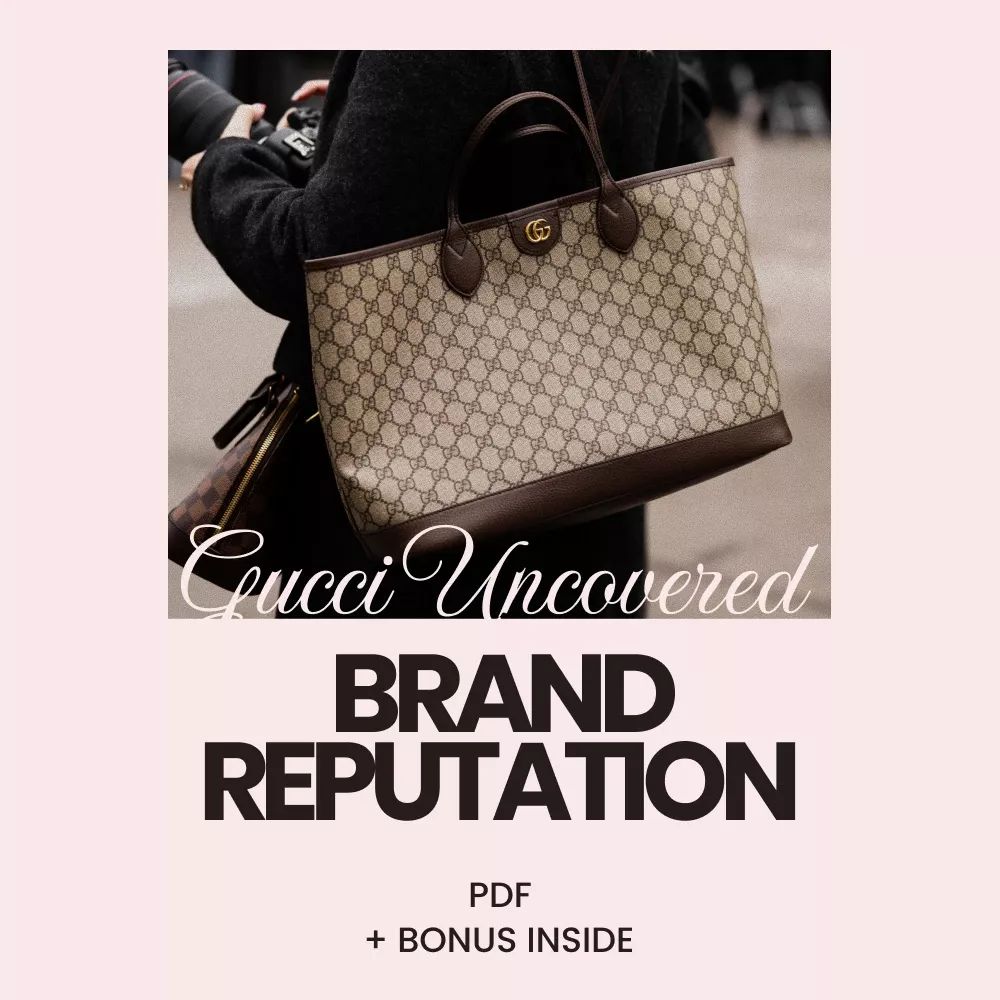
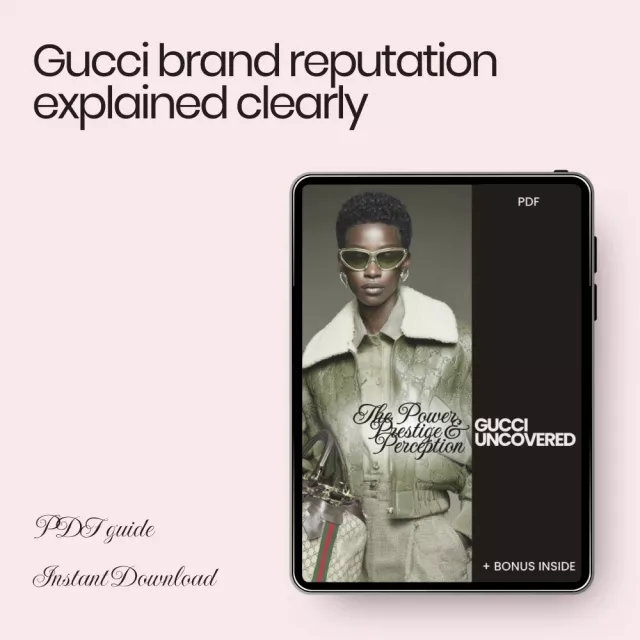
What makes a fashion house more than just a label? Why does a logo become a symbol of power, prestige, and identity? Gucci Uncovered: The Power, Prestige & Perception is a deep dive into the strategy, psychology, and cultural influence behind one of the world’s most iconic luxury brands. This professionally written digital eBook delivers gucci brand reputation explained in a way that is clear, insightful, and immediately useful for entrepreneurs, marketers, students, and brand strategists.
This is not just a history lesson. It is a masterclass in brand building, reputation management, luxury positioning, and cultural relevance.
This eBook is perfect for:
Unlike surface-level fashion blogs, this guide breaks down the mechanics behind prestige. You will not just learn what happened — you will understand why it worked. With real case studies, strategic breakdowns, and practical positioning insights, this digital download connects heritage, psychology, marketing innovation, and cultural timing into one powerful framework.
It translates luxury theory into practical lessons you can apply to your own brand, content, or business immediately.
This is a downloadable eBook, giving you immediate access after purchase. Read it on your tablet, laptop, or phone and revisit the insights anytime you need brand clarity or creative inspiration.
If you are ready to understand the power behind prestige and finally see gucci brand reputation explained in a strategic, actionable way, click Add to Cart now and start uncovering the blueprint behind luxury dominance today.
All orders can be cancelled until they are shipped. If your order has been paid and you need to make a change or cancel an order, you must contact us within 12 hours. Once the packaging and shipping process has started, it can no longer be cancelled.
Your satisfaction is our #1 priority. Therefore, you can request a refund or reshipment for ordered products if:
We do not issue the refund if:
*You can submit refund requests within 15 days after the guaranteed period for delivery (45 days) has expired. You can do it by sending a message on Contact Us page
If you are approved for a refund, then your refund will be processed, and a credit will automatically be applied to your credit card or original method of payment, within 14 days.
If for any reason you would like to exchange your product, perhaps for a different size in clothing. You must contact us first and we will guide you through the steps.
Please do not send your purchase back to us unless we authorise you to do so.
Your purchase will be available to download once payment is confirmed.
Instant download items don’t accept returns, exchanges or cancellations. Please contact us if you have any problems










The Tom Ford case study in Chapter 2 is the best breakdown of brand reinvention I've read — velvet suits, daring campaigns, and how provocation can strengthen rather than erase heritage. That section alone reframed how I think about creative direction.
Chapter 5 on luxury psychology explained why I've been willing to pay premium prices better than I could explain it myself.
The scarcity and identity signaling section in Chapter 5 articulates something every brand strategist knows intuitively but struggles to put into frameworks. The distinction between scarcity as marketing tactic versus scarcity as core luxury psychology is sharp. I used the overexpansion warning as a talking point in a client presentation last week and it landed immediately.
The Florence origin story angle in Chapter 1 — geography as brand authority — is an insight I haven't seen articulated this clearly anywhere else 🔥
Reads like a luxury branding masterclass disguised as a Gucci history.
The family feuds chapter is gripping storytelling. The guide doesn't shy away from the messy parts of Gucci's history, and the insight that internal conflict bleeds into public perception is something I've watched happen at companies I've worked for. The controversy response framework in Section 3.4 — acknowledge, correct, reinforce — is practical enough to pin to a wall.
Chapter 4's AI prompt examples for luxury brand copy are immediately usable.
Good content on brand psychology but the AI sections feel surface-level compared to the historical analysis. Chapter 6 mentions trend forecasting and personalized experiences without explaining how Gucci actually implements them. The heritage and reputation chapters are strong enough to carry the guide, but the tech angle needs more specificity.
The logo economy section connected dots I'd never thought about — how the GG became social currency before anyone used that term.
⭐🔥👜💯
I run a streetwear brand and was stuck on how to balance visibility with exclusivity. Chapter 2's section on the art of scarcity gave me the framework I needed. I'd been chasing volume — more drops, more colorways, more SKUs — and wondering why perceived value kept declining. The overexpansion warning hit hard. Since reading this I've cut my next release from twelve pieces to five and restructured pricing around controlled availability. Early pre-order interest is already stronger than anything from my last full collection. The Tom Ford case study also gave me language for pitching creative risks to my business partner, who tends to play it safe.
The House of Gucci film analysis in Chapter 3 is the most nuanced take I've seen on how scandal can fuel brand mystique.
Chapter 1's reputation lesson — luxury brands are built on perception, not products — is worth the entire download.
The emotional branding breakdown in Section 5.3 gave me vocabulary for concepts I've been circling around in my own marketing work. Storytelling, experiential engagement, and community as pillars of status consumption — all framed through specific Gucci examples rather than abstract theory.
Wish the Web3 and NFT section in Chapter 6 went deeper. It mentions virtual sneakers and limited NFT releases but doesn't analyze whether these experiments actually worked or how they affected brand perception. The rest of the guide is analytical and specific, so this section's brevity stands out.
The equestrian heritage connection to aristocratic image is such a smart origin analysis.
I teach brand strategy at a business school and Chapter 5 on luxury psychology maps directly onto concepts I spend weeks building up to. The framework of exclusivity, status signaling, and emotional branding as three pillars of premium pricing is clean enough for a lecture slide but substantive enough for real strategic application. Already assigned it as supplementary reading.
Clean writing, no filler, every chapter earns its place.
The Alessandro Michele section does a good job explaining how inclusivity and eclecticism became strategic tools rather than just creative choices. The connection between gender-fluid collections, diverse casting, and renewed desirability is drawn clearly.
❤️👌🇮🇹⭐
The brand positioning mistakes section is where I kept nodding. Overextending, ignoring cultural sensitivity, neglecting storytelling — I've watched brands I follow make every single one of these errors in real time. Having them named and analyzed through Gucci's own experience makes the lessons concrete rather than theoretical 👏
Chapter 2's heritage-as-competitive-barrier concept reframed how I think about my own brand's origin story.
Solid luxury branding primer but leans heavily on Gucci's wins without critically examining its current challenges. The guide acknowledges past controversies and family drama but doesn't address the brand's more recent creative director transitions or the question of whether the Michele-era maximalism has staying power. A more balanced analysis would strengthen the credibility of the strategic lessons.
The visibility-equals-conversation framework in Chapter 2 is deceptively simple and completely right.
Six chapters, zero wasted pages.
I was building a DTC jewelry brand and kept defaulting to discounts to drive sales. Chapter 2's section on craftsmanship and scarcity convinced me to stop. I pulled my 20% off promotion, reduced my collection to eight core pieces, and repositioned around limited quarterly releases. Three months later my average order value is up and I'm getting tagged in unboxing content for the first time. The guide's framework — limited supply increases demand, high price signals quality, selective distribution protects prestige — sounds obvious but I needed to see it articulated through Gucci's century-long execution to actually commit to it.
The practical insight boxes after each section keep the guide actionable rather than just informational.
Good guide but the AI copywriting prompts in Chapter 4 feel out of place. The rest of the guide analyzes Gucci's strategy at a high level, then suddenly there's a section about generating Instagram captions. The tonal shift is jarring. The marketing strategy analysis around celebrity endorsements and hype creation is strong — the prompt examples just don't match the depth of everything else.
The crisis response blueprint in Section 3.4 — acknowledge, correct, reinforce — should be standard reading for any brand manager.
Chapter 3 treats controversy as a strategic variable rather than a disaster, and that reframe alone is worth the read.
I'm a luxury marketing consultant and I've been looking for a concise resource to send to clients who don't understand why premium pricing works. Chapter 5 does the job. The section on why consumers pay premium prices breaks down exclusivity, status, and quality signaling without being condescending. I've sent the PDF to three clients this month and each one came back with sharper questions about their own positioning 💎
The sustainability section in Chapter 6 needed more depth. It mentions eco-friendly materials and supply chain transparency but doesn't examine whether these initiatives have measurably affected Gucci's brand perception or sales among younger consumers. The rest of the guide supports its claims with case studies and outcomes — this section reads more like a press release.
The luggage-to-luxury expansion arc in Chapter 1 is the most concise version of this story I've found.
Treats Gucci as a case study in perception management, not just fashion history.
🔥👜⭐👍✨
The celebrity endorsement analysis in Chapter 4 goes beyond surface-level observation. The guide explains why specific partnerships work — not because celebrities are famous, but because the right ones embody the brand's persona and translate admiration into consumer desire. That distinction matters for anyone trying to replicate the strategy.
The double-G as social currency is the kind of framing that sticks with you.
Chapter 5's common positioning mistakes section names three specific pitfalls — overextension, cultural insensitivity, and neglecting narrative — that I see emerging brands fall into constantly. Having them tied to Gucci's actual experience rather than hypotheticals makes the warnings land harder.
I came for the Gucci history, stayed for the brand strategy frameworks.
The guide covers a century of brand evolution in six tight chapters without feeling rushed. The only section that could use more development is the digital future chapter — Web3, virtual fashion, and AI-driven design each get a paragraph or two when they deserve full case studies. Given how thoroughly the guide treats the Tom Ford reinvention and Michele revival, the digital era section feels abbreviated by comparison.
The reinvention lesson from the Tom Ford era — that heritage and innovation can coexist — is something I keep coming back to in my own work.
I started a small fragrance brand two years ago and struggled to justify premium pricing to myself, let alone to customers. Chapter 5 changed that. The framework that price signals quality and ownership signals belonging gave me language for what I was trying to do instinctively. I rewrote my entire brand story using the heritage anchoring concept from Chapter 1 — rooting my line in my grandmother's perfume collection from the 60s rather than generic ingredient lists. Since the rebrand, my conversion rate has doubled and I've had two wholesale inquiries from boutiques that previously ignored my outreach. The scarcity psychology section also convinced me to limit my seasonal releases to three fragrances instead of eight.
The social media strategy breakdown explains why Gucci feels modern without diluting luxury — most brands can't pull that off.
Well-written and insightful on the reputation side, but the guide largely ignores Gucci's financial mechanics. How do controlled releases actually affect revenue? What's the real margin impact of scarcity strategies? The psychological and strategic analysis is strong, but a guide about power and prestige should engage with the business model beneath the brand perception.
Sharp, well-structured, and immediately applicable to non-fashion brands too 🔥
The guide's strongest insight is that Gucci sells perception, not products — and every chapter reinforces that thesis from a different angle.
Chapter 6's emerging brand lessons distill six chapters into five actionable principles without oversimplifying. I printed them out.